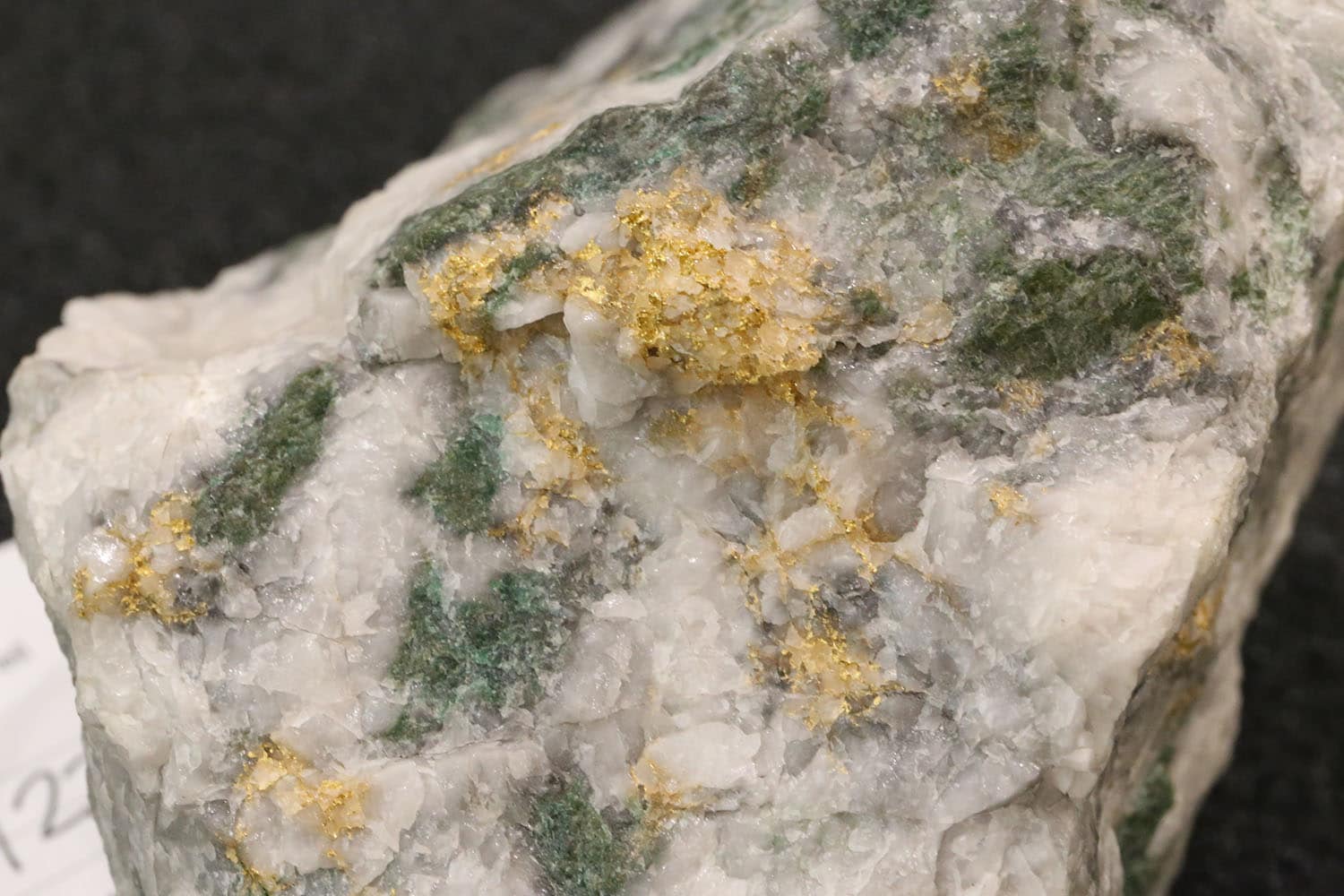
Gold Candle Ltd. annonce une mise à jour de ses ressources aurifères.
Gold Candle Ltd. (« Gold Candle » ou la « Société ») a le plaisir de présenter les résultats d’une mise à jour de l’estimation des ressources minérales de son projet Kerr-Addison, détenu à 100 %. Ce projet est situé à l’est de Kirkland Lake, dans le canton de McGarry, district de Timiskaming, en Ontario, au Canada. En utilisant un prix de l’or de 1 800 $ US l’once et une teneur de coupure de 0,35 g/t Au, les ressources minérales estimées par catégorie, à l’intérieur d’une enveloppe de fosse servant à la déclaration des ressources, sont les suivantes :
- Catégorie indiquée : 32,5 Mt à 1,70 g/t Au = 1,8 million d’onces d’or
- Catégorie présumée : 79,1 Mt à 1,32 g/t Au = 3,4 millions d’onces d’or
La ressource minérale entoure l’ancienne mine souterraine Kerr-Addison, l’une des plus importantes mines d’or du Canada, qui a produit 11 millions d’onces d’or entre 1938 et 1996. La ressource comprend une minéralisation située sous les anciennes teneurs de coupure et qui enveloppe les zones précédemment exploitées. Cela inclut une minéralisation qui ne pouvait pas être exploitée de façon économique par des méthodes souterraines en raison d’une combinaison de teneur, du faible prix de l’or et de la géométrie du gisement. Cette estimation des ressources minérales a été réalisée par Lions Gate Geological Consulting Inc. (LGGC) à partir d’un modèle géologique élaboré par les géologues de Gold Candle.
Points saillants du projet
- la nouvelle estimation confirme une importante ressource aurifère à des teneurs qui se comparent favorablement à celles des mines d’or à ciel ouvert actuellement en exploitation dans la région ;
- un tiers de la ressource est classé dans la catégorie indiquée ;
- la propriété est située dans une juridiction minière établie, adjacente à une autoroute et bénéficiant d’un accès à l’électricité, au rail et à l’eau ;
- aucun enjeu technique, environnemental ou social n’a été identifié qui empêcherait le développement du projet.
La propriété Kerr-Addison couvre six kilomètres (km) de la faille de Larder Lake–Cadillac, une structure géologique associée à plus de 100 millions d’onces d’or entre Matachewan, en Ontario, et Val-d’Or, au Québec. Peu de forages ont été réalisés sur la propriété à l’extérieur de l’empreinte immédiate de la mine, ce qui représente une occasion d’exploration intéressante en périphérie et en profondeur de l’ancienne mine.
Prochaines étapes
La Société a lancé un programme de forage de 40 000 mètres (m) afin de rechercher de nouveaux gisements et de continuer à améliorer la confiance dans les ressources minérales. Les forages de définition prévus seront concentrés sur la partie plus profonde de la ressource dans le but de reclassifier certaines ressources actuellement présumées en ressources indiquées. Ces ressources sont situées sous la majorité des forages réalisés par Gold Candle et sont actuellement classées dans la catégorie présumée.
L’estimation des ressources sera mise à jour de nouveau une fois ce programme de forage terminé, ce qui est prévu d’ici la fin du deuxième trimestre de 2024. En plus des forages près de la mine, les travaux d’exploration se poursuivront le long de la faille de Larder Lake–Cadillac à l’est de Kerr-Addison. Après l’analyse de toutes les données historiques, des trous d’exploration seront forés sous les anciens travaux miniers.
Une analyse économique de niveau conceptuel sera entreprise sur la base de la récente estimation des ressources minérales, avec une finalisation prévue au quatrième trimestre de 2023. Une étude économique préliminaire (PEA), guidée par les résultats de cette étude conceptuelle, sera réalisée au second semestre de 2024 après la prochaine mise à jour des ressources.
Perspectives raisonnables d’extraction économique éventuelle
Les ressources minérales sont contenues à l’intérieur d’une enveloppe de fosse servant à démontrer les « perspectives raisonnables d’extraction économique éventuelle », conformément au Règlement national 43-101 sur l’information concernant les projets miniers (« NI 43-101 »). Les ressources minérales indiquées et présumées ont été incluses dans l’enveloppe de fosse servant à la déclaration des ressources.
Une teneur de coupure nominale de 0,35 g/t Au a été utilisée pour la déclaration des ressources minérales. La sensibilité des ressources minérales indiquées et présumées à la teneur de coupure est présentée dans le tableau ci-dessous. Cette comparaison est limitée aux ressources minérales contenues à l’intérieur de l’enveloppe de fosse basée sur un prix de l’or de 1 800 $ US l’once.
| Pit shell (US$) | Cut-off (Au g/t) | Class | Tonnes (Mt) | Gold (g/t) | Gold (Oz) |
|---|---|---|---|---|---|
| 1800 | 0.15 | Indicated | 36.8 | 1.53 | 1,800,000 |
| 1800 | 0.20 | Indicated | 35.9 | 1.56 | 1,800,000 |
| 1800 | 0.25 | Indicated | 34.9 | 1.60 | 1,800,000 |
| 1800 | 0.30 | Indicated | 33.7 | 1.65 | 1,800,000 |
| 1800 | 0.35 Base Case | Indicated | 32.5 | 1.70 | 1,800,000 |
| 1800 | 0.40 | Indicated | 31.1 | 1.76 | 1,800,000 |
| 1800 | 0.45 | Indicated | 29.8 | 1.81 | 1,700,000 |
| 1800 | 0.50 | Indicated | 28.5 | 1.87 | 1,700,000 |
| 1800 | 0.15 | Inferred | 158.4 | 0.77 | 3,900,000 |
| 1800 | 0.20 | Inferred | 127.5 | 0.92 | 3,800,000 |
| 1800 | 0.25 | Inferred | 106.0 | 1.06 | 3,600,000 |
| 1800 | 0.30 | Inferred | 90.9 | 1.19 | 3,500,000 |
| 1800 | 0.35 Base Case | Inferred | 79.1 | 1.32 | 3,400,000 |
| 1800 | 0.40 | Inferred | 62.9 | 1.46 | 3,200,000 |
| 1800 | 0.45 | Inferred | 61.4 | 1.59 | 3,100,000 |
| 1800 | 0.50 | Inferred | 55.3 | 1.71 | 3,000,000 |
Note: Mineral Resources are not Mineral Reserves and do not have demonstrated economic viability. There is no certainty that all or any part of the Mineral Resources estimated will be converted into Mineral Reserves. The estimate of Mineral Resources may be materially affected by environmental, permitting, legal, title, taxation, socio-political, marketing, or other relevant issues. The CIM definitions were followed for the classification of Indicated and Inferred Mineral Resources. Ounces and tonnes have been rounded to the nearest 10,000 therefore sums in the table may not add-up due to rounding.
For comparison purposes, additional resource limiting pit shells were generated at gold prices from US$1,400/oz to $2,300/oz at $100 increments. The results from this work are summarized in the table below.
| Pit shell (US$) | Cut-off (Au g/t) | Class | Tonnes (Mt) | Gold (g/t) | Gold (Oz) |
|---|---|---|---|---|---|
| 1400 | 0.35 | Indicated | 30.2 | 1.67 | 1,600,000 |
| 1500 | 0.35 | Indicated | 30.7 | 1.67 | 1,600,000 |
| 1600 | 0.35 | Indicated | 31.4 | 1.69 | 1,700,000 |
| 1700 | 0.35 | Indicated | 31.5 | 1.69 | 1,700,000 |
| 1800 | 0.35 Base Case | Indicated | 32.5 | 1.70 | 1,800,000 |
| 1900 | 0.35 | Indicated | 32.6 | 1.70 | 1,800,000 |
| 2000 | 0.35 | Indicated | 32.9 | 1.71 | 1,800,000 |
| 2100 | 0.35 | Indicated | 32.9 | 1.71 | 1,800,000 |
| 2200 | 0.35 | Indicated | 34.7 | 1.72 | 1,900,000 |
| 2300 | 0.35 | Indicated | 35.0 | 1.73 | 1,900,000 |
| 1400 | 0.35 | Inferred | 73.3 | 1.32 | 3,100,000 |
| 1500 | 0.35 | Inferred | 74.4 | 1.32 | 3,200,000 |
| 1600 | 0.35 | Inferred | 75.9 | 1.32 | 3,200,000 |
| 1700 | 0.35 | Inferred | 76.2 | 1.32 | 3,200,000 |
| 1800 | 0.35 Base Case | Inferred | 79.1 | 1.32 | 3,400,000 |
| 1900 | 0.35 | Inferred | 79.9 | 1.32 | 3,400,000 |
| 2000 | 0.35 | Inferred | 80.9 | 1.32 | 3,400,000 |
| 2100 | 0.35 | Inferred | 81.0 | 1.32 | 3,400,000 |
| 2200 | 0.35 | Inferred | 87.1 | 1.33 | 3,700,000 |
| 2300 | 0.35 | Inferred | 89.6 | 1.34 | 3,800,000 |
Note: Mineral Resources are not Mineral Reserves and do not have demonstrated economic viability. There is no certainty that all or any part of the Mineral Resources estimated will be converted into Mineral Reserves. The estimate of Mineral Resources may be materially affected by environmental, permitting, legal, title, taxation, socio-political, marketing, or other relevant issues. The CIM definitions were followed for the classification of Indicated and Inferred Mineral Resources. Ounces and tonnes have been rounded to the nearest 10,000 therefore sums in the table may not add-up due to rounding.
The main economic inputs used during pit shell generation are summarized in the table below. Note that these inputs are based on limited test work and order-of-magnitude cost estimates. They are used only to demonstrate reasonable prospects for eventual economic extraction.
| Gold price | US$ 1,800/oz |
| Mining cost | C$ 3.00/t mined |
| Process cost | C$11.00/t processed |
| G&A | C$4.50/t processed |
| Pit slope angle | 44 to 48 degrees |
| Density | 2.81 t/m³ |
| Recovery | 90% |
Other Work on the Project
In addition to drilling to upgrade resources, Gold Candle has completed various investigations related to potential extraction of the resource as well as exploration activities.
Metallurgy: Results from a series of variability tests and four composites indicates that most of the resource would be amendable to gold recovery using a standard cyanide mill with an estimated recovery of 91%.
Geotechnical and hydrogeological studies: Six geotechnical holes and four hydrological holes were drilled in 2022 for a total of 3,600 m as part of a study to determine potential pit slope angles. Preliminary recommended overall pit slope angles are 44 to 48 degrees. Additional work is required to optimize slope angles.
Waste rock characterization: Results from a preliminary test program on potential waste rock concluded that most of the waste rock and mineralized material will not generate acidity upon exposure to the environment. It also suggests that standard waste rock management practices would be sufficient for the Kerr-Addison waste rock handling and storage with limited, if any, selective handling of waste rock.
Environment: Preliminary evaluations noted some environmental sensitivities including fish habitat in the Project area which will need to be addressed in Project planning, but no factors were identified that would preclude Project development.
Exploration: A 975 line-km airborne magnetic survey with lines spaced 25 m apart was flown in 2022 to guide exploration along the Larder Lake Cadillac Break. Most of Gold Candle’s drilling up to the end of 2022 focused on defining the deposit proximal to historical mining. Exploration drilling targeted on the potential for new discoveries is now underway.
Legacy Issues: The Company continues to be proactive in investigating and addressing issues stemming from past mining activities and ensuring site safety in collaboration with provincial authorities. This includes removing hazardous materials left on site, repairing and maintaining perimeter safety fencing, conducting systematic surface water sampling and a study on the causes and potential mitigation strategies in an area where surface waters contain elevated metal content.
Community Engagement: Gold Candle believes that any potential mine development should be conducted in a manner that brings positive impacts to all the people living in the area. The Company is working to engage with the neighbouring communities and Indigenous Communities and Organisations (ICOs). Initiatives to date include town hall meetings and a site visit from an ICO.
Opportunities
Opportunities at Kerr-Addison include:
- Potential for the discovery of new mineralization in the highly prospective rocks around the known deposit. Historically, there was very limited drilling outside of the areas mined. Results that are available show that the mineral system continues in areas peripheral to, and below, old stopes. As an example, an intersection of 9.0 m averaging 12.7 g/t Au in a historical drill hole, 1,400 m below surface and well below the stopes, illustrates the exploration potential outside of the current resource.
- Potential additions to the resource are possible if further work can demonstrate that a less conservative approach in estimating material around stopes and in restricting the influence of high-grade assays is justified.
- In the lower part of the resource there is relatively little drilling in the hanging wall of the historic stopes. There is potential for additional resources in this area
Risk Factors
The Project is subject to the normal risks that mining projects face including changes in metal prices, changes to government regulations, social risks, uncertainty in mineral resource estimates, permitting risks and financial risks. The McGarry Township communities were developed around the historic Kerr-Addison Mine. Any potential development of the resource will impact the communities.
The Company hasn’t identified any factors to date which would preclude further exploration or reasonable prospects of eventual economic extraction.
About the Kerr-Addison Deposit
The Kerr-Addison deposit is an orogenic gold deposit that is located in the late Archean Abitibi greenstone belt of the Superior Province. Mineralization is in the immediate structural footwall of the Larder-Lake-Cadillac Deformation zone (LLCDZ), which is defined by a high-strain zone near the contact between the Timiskaming assemblage and a panel of ultramafic and mafic volcanic rocks, known as the Larder Lake group. This deformation zone is a 250 km, east-west trending, regional crustal scale fault, that extends from Matachewan, Ontario to Val-d’Or, Québec, which has a fundamental control on the distribution of gold deposits.
Gold occurs primarily in a dense stockwork of veins, as free gold, and is also associated with fine-grained, disseminated pyrite and arsenopyrite. Carbonate ore historically accounted for production of over 3.7M oz Au in an alteration assemblage of green-chromium-muscovite (fuchsite), quartz, and magnesite-ankerite with intense quartz carbonate veining. Flow ore historically accounted for production of ~ 7.1M oz Au in an alteration assemblage of quartz-chlorite and carbonate, with variable amounts of sericite, albite, pyrite, and graphite. In general, flow ore bodies are located in the structural footwall (south) of the green-carbonate ore bodies.
Mineral Resource Notes
A total of 313,496 assays from 503,242 m of drilling were used in the mineral resource estimate. Of the total drilled metres on the project, 18% were drilled by Gold Candle starting in 2017 and the remainder was drilled by previous operators of the property. Various studies were undertaken to support the use of historical assay information in the resource estimation. As the amount of assay data for other potentially economic metals within the deposit, including silver, is restricted to Gold Candle drilling, only gold was estimated.
Considerable effort was undertaken to ensure that the resource estimation was not influenced by material that was mined historically. A model of the historic workings was created from digitized stope plans. No assays from within modelled stopes or from historic holes within a 0.5 m buffer around stopes were used in the estimation. Additionally, stopes and a 1 m buffer around stopes, were assumed to be waste (have zero grade).
Prior to estimating block grades, potentially anomalous outlier grades were identified and their influences on the grade model was controlled during interpolation through the use of traditional top‐cutting and outlier restrictions. Overall, this led to a reduction of approximately 10% in the total ounces of gold between a resource model with no grade restrictions and the resource estimate reported herein.
Mineral resource estimation was by ordinary kriging into 10x10x10 m blocks using four domains based on stratigraphy and mineralization statistics. Assays were first composited into 1.5 m lengths. A minimum of four to five composites and a maximum of 18 to 24 composites were used to estimate the grade of each block depending on the domain. Every block required composites from a minimum of two drill holes for the grade to be estimated. An in situ density of 2.81 t/m3 was used based on 3,109 bulk density measurements on drill core taken by Gold Candle.
Indicated Mineral Resources were assigned if a block was within 35 m of two drill holes and Inferred Mineral resources if a block was within 65 m of two drill holes.
Mineral resources were classified in accordance with the Canadian Institute of Mining, Metallurgy and Petroleum (« CIM ») « CIM Definition Standards – For Mineral Resources and Mineral Reserves » adopted by the CIM Council (as amended, the « CIM Definition Standards ») in accordance with the requirements of NI 43-101. Mineral resource estimates reflect the reasonable expectation that all necessary permits and approvals will be obtained and maintained.
There is no guarantee that any of the mineral resources will be converted to mineral reserve. There is also no guarantee that any of the inferred mineral resources will be upgraded to measured or indicated mineral resources or to mineral reserves. Mineral resources that are not mineral reserves do not have demonstrated economic viability.
QA/QC and Data Verification
Gold Candle has a comprehensive QA/QC program that meets industry standards. The sampling data used for the mineral resource estimate was verified by LGGC. Drillholes used in the mineral estimation were selected at random and the collar, survey and assay data were compared to original sources. LGGC is satisfied that the database is acceptable for inclusion in a mineral resource estimation.
Comparison with Previous Mineral Resource Estimate
The updated mineral resource estimate supersedes the Inferred Mineral estimate of 169.0 Mt @ 1.12 g/t Au totalling 6.1M Au detailed in NI 43-101 Technical Report, Gold Candle Ltd, Kerr-Addison Mine Property, Virginiatown, Ontario, Canada, February 23, 2021 by R. Sim and B. Davis and filed on SEDAR. The previous resource estimate was all in the Inferred category while the 2023 estimate includes higher confidence Indicated category material. The updated estimate includes results from an additional 42,462 m of drilling by Gold Candle, primarily in the upper 300 m of the deposit, that were completed after the 2021 estimate.
The updated estimate incorporates a more conservative approach with regards to information from around old workings than the 2021 estimate used. Planned improvements to the stope model may reduce the need for these approaches. Another conservative approach used in the new estimate but not in the 2021 estimate is some historical gold assays at the reported assay detection limit of 0.01 oz/t (0.34 g/t) or 0.02 oz/t (0.68 g/t) were reduced to 0.1 g/t Au prior to compositing the assays for grade interpolation. This impacted 34,980 assays or 10% of the assays used in the estimate for drillholes completed by Kerr-Addison Mines Ltd, Chesterville Mines Ltd, and GSR Mining Corp between 1937 and 1995. This was done because the original results at the detection limit were not considered reliable and are higher than the reporting cut-off. Areas that may have mineralization in the 0.3 to 0.6 g/t Au range that are not supported by Gold Candle drilling will require additional drilling in order to be included in future estimates.
Qualified Persons
The mineral resource estimate was conducted by Susan Lomas, P.Geo. of Lions Gate Geological Consulting Inc. and Bruce Davis, PhD, FAusIMM, each of whom is an Independent Qualified Person under NI43-101 standards.
The technical information in this news release has been reviewed and approved by independent QP Susan Lomas, P.Geo.
An independent technical report prepared in accordance with the requirements of NI 43-101 will be completed within 45 days of this news release.
About Gold Candle
Gold Candle is a privately funded Canadian exploration company led by a diverse and highly experienced group of mining professionals. In 2015, the Company acquired claims over the historic Kerr-Addison Gold Mine and surrounding area in the McGarry Township, located in the Timiskaming District of Ontario. Our approach to responsible mineral exploration is to perform our activities in a manner that benefits local communities, employees and shareholders and respect people and the environment.